[Home | Curriculum vitae | Marginalia]
[The Velvet Lantern series:The Velvet Lantern | Ceremony | Tricolour - The Passion of Joan of Arc | Manuscript - In Slower Motion | Before the Fall | An essay on Michelangelo Antonioni's 'Blow Up' | Blow Up Cardiff | Sunlight and Dirt | Winter Scatters Berries on Brittle Snow | Black Narcissus]
[Fork I: Barricade | Fork II: The Tower of Destruction | Fork III: Vanishing Point | Aside: Eight Voices in Darkness]
...with the black flag that flutters at the end I shall cover myself over in order to die...
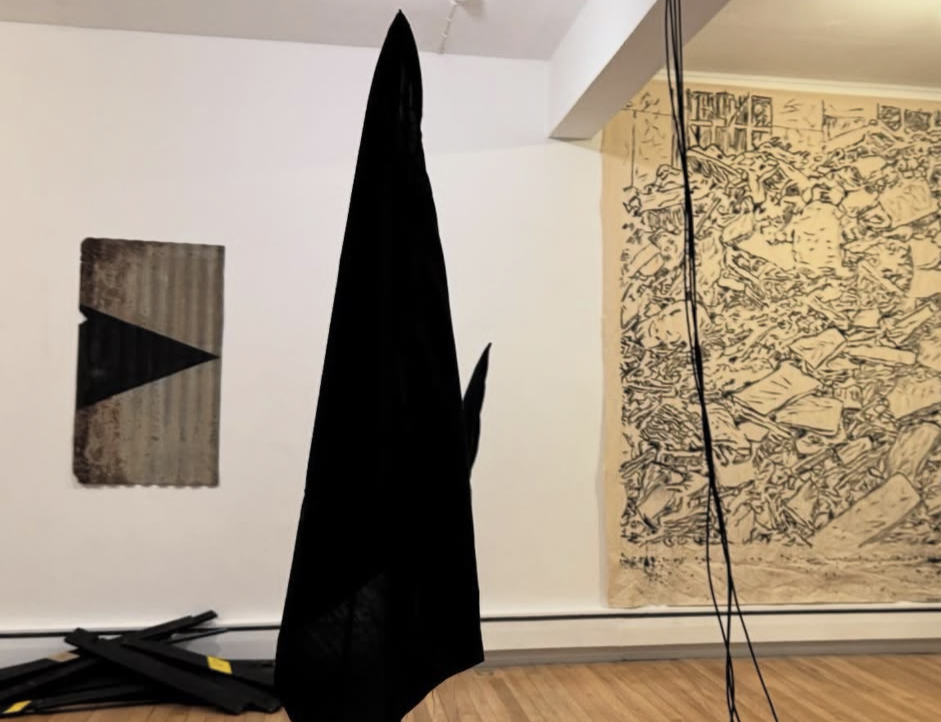
Following on from Barricade I made The Tower of Destruction - the title being a reference to the tarot card that stands as a symbol for the fall of the great houses and thus, to my mind, a symbol for Tragedy.
Where did this work come from? I had the idea about 10 years ago for a work I was to call Love Letters. I was interested in the connections between historical figures - composers, artists, writers, philosophers, scientists - Nietzsche to Lou Salome to Freud to Jung; Nietzsche to Wagner to Schopenhauer; Lou Salome to Rilke and Wedekind; and so on. I was aiming to gather the relevant epistemological data - letters and so on - to form a chain of correspondence linking all of these people - tracing a web through history - European history at least. I wanted to set them against film clips from black and white Hollywood movies - those cliched close ups of hands writing letters. Anyway, as usually happens when I work conceptually, I either stick to it rigidly, or allow it to be absorbed into something more sprawling, which is what happened.
Picking up the themes from within Barricade, I developed a set of poems. The first was my dedication to Luigi Nono, written for that installation (see Barricade). The remaining poems explored my personal responses to certain cultural products and events covering a period of history from the French Revolution to the Twin Towers attack.This was rendered into Welsh by the excellent Nia Wyn Roberts.
In this space at Turner House we have an interesting arrangement. The two floors obviously share the sound due to the large opening between the floors, but in my arrangement, where the loudspeakers are arranged around the walls upstairs, there are two broad listening experiences - upstairs the sound is easy to locate from individual speakers and is more detailed, while downstairs you have a kind of mono mix of the whole, with a muting of some of the detail.
I made two distinct uses of the eight loudspeaker arrangement - individual voices and panned, mobile, sounds. Regarding the former, by breaking up Angharad's speech into fragments - using a mix of automation and manual control - each loudspeaker carries a fragment of the narration at any moment. Therefore there are passages where the speech is continuous, but fragmented and distributed between the 8 speakers.
Another method is panning between pairs of speakers. In this case, using dynamic reverb on the speech to create prolonged sounds from short utterances, I automated a system of panning. This is fairly discreet, not an attempt at traceable movement through space - rather a way of animating the sound throughout the space - producing a sense of movement. The system would pick a new target loudspeaker and pan towards it and so on.
Anyway, the point being, that kind of detail is audible upstairs while downstairs the sound is tamed.
The soundtrack is in 14 sections - the fourteen operas of the title - and each section is divided into a sequence of 6 segments: a narration; 2 choruses; a chant, a song, and another segment.
The narrations are Welsh language versions of a text from the overall 'libretto', as I like to call it. The speech is broken up as described above but also with certain quiet details such as inhalations exaggerated (using what's called a transfer function) to provide a more percussive sound to animated Angharad's voice. A kind of polyphony is provided by randomised offsets from the current timepoint so that there are irregular echoes and premonitions at slighly adjusted pitches. I was a bit concerned as to how I could integrate speech into the overall sound. This really only got solved through experiment - which is where using software like Max or Pure Data is indispensible to my practice. I regard programming as part of composing as much as writing notes or improvising on instruments - it's composing where you can experiment direcly with the results - it enables a mixture of writing, performing and testing.
Another rewarding part of this project was running a vocal workshop to produce the chorus materials of the soundtrack. About 17 keen amateurs and novices of all ages gathered here for a workshop session led by one of the professional singers, Sarah Dacey. I basically provided a text of words to chant and sing. The most effective part was when they all had to pick a pitch in their heads and sing a word, holding the pitch unvaried for a few seconds, creating an ethereal, glassy texture. The exercise was repeated by a group in Newcastle University and I assembled the pieces together to form the 28 chorus segments distributed throughout the work.
There are also segments of Sarah Dacey singing asemic phonetic alphabet passages set to melodies that were originally used in woodwind recordings for Sunlight and Dirt.
Finally, I reused the Love Duet material the Grace Curtis provided for Barricade.
These sections in total last longer than the gallery's opening hours, so one cannot experience the entirety of the audio or the text in one sitting. Each 'opera' lasts about 25 minutes.
While these classical references seem rather fanciful, they are a kind of glue between the ancient past and the recent past - even the present. One must think of them both as metaphorical and literal. They are the stuff of operas, particularly from the baroque period, yet the choruses here, for example, are choruses in the modern sense of choral singing, whilst also alluding to the Greek model. Similarly, the Sirens are meant to be the mermaids of Homer's epic poem, while also implying a kind of signal demanding attention.
In mythology there are demi-gods and malevolent spirits that are given tasks related to the needs of the gods for justice, vengeance, or simply to supply warriors. The Valkyries of Norse mythology are the warrior women who choose dead heroes from the battlefield to populate Valhalla. These are, of course, exemplified in Wagner's second most popular piece of music - The Ride of the Valkyries. We also have the banshees of Scottish lore. Then we have the Furies of Greek myth who tormented Prometheus for the crime of enlightening mankind - a Greek 'original sin'. In Euripides' tragedy the Furies were transformed by Athena into the Eumenides whose role is slightly more associated with modern systems of justice - a police force rather than punishers and tormentors of the criminal.
The Keres are different in that they are mere parasites, feeding on the dead in battle. Unlike the Valkyries in Norse myth who are choosing the worthy warriors from the dead, the Keres simply wait and feed on them. The only opera I know of that casts them is Harrison Birtwistle's Minotaur. For me, they stand as a simple sign for the numerous human parasites in our modern era.
The Sirens find their way into this work via Homer's Ulysses. These mermaids seduce sailors to their doom in the waters by their singing. Ulysses - always applying his intelligence - plugged his sailors' ears with wax to deafen them to the alluring song. He, on the other hand, was lashed to the mast to prevent him from following the Sirens while enjoying the torment of their seductive song. This was obviously a masochistic act.
The choruses - formed from materials recorded in two vocal workshops, one in Turner House and one in Newcastle University - are labelled as 'strophe' and 'antistrophe' in line with Greek tragic choruses. These are a kind of call-and-respond in Greek tragedy. I've used the idea to frame parts within each 'opera'. Some are accompanied by stamping and clapping - the most abrasive aspect of the whole audio experience. I like to think of these percussive moments as exorcising malevolent spirits.
I attempted a few vocal experiments: asemic singing; chanting; setting words according to syllabic 'fit'. There is also sung material that is my own setting of words by Richard Wagner from 'Tristan und Isolde'. I regard the latter as an iconoclastic move, since one is not expected to meddle with the sacred. These settings are barely discernible in the Keres sections - it could be suggested that, like Keres, I preyed upon Wagner's words and tore them apart. These bear the voice of Grace Curtis, who was stylistically the most operatic of my singers.
The asemic singing (singing that has no meaningful text) was carried out by Sarah Dacey (of the Riot Ensemble), who also led the vocal workshop for the chorus sections. The text was indicated by the International Phonetic Alphabet with the aim of creating a meaningless vocal utterance.
The poem and its chants were spoken and sung by Angharad van Rijswijk (aka ACCU). For the chants, I used a 12-note series from my first attempt at writing for an instrument back in 1994. Angharad sang the series by chanting individual lines on one note each, allowing me to assemble them as a polyphony. For the speech, I abstracted transient sounds from the recordings to make certain inhuman, explosive sounds.
The 'folk songs' were an experiment with setting text. First of all, I had a set of seven melodies recorded first on a kaval by Katie Stevens. The kaval is a Balkan shepherd's flute. These recordings are given at the start of each of the folk songs. These are then processed with custom software to form a long backdrop to the vocal part, which uses the same melody. The words - abstracted from a translation of Dante's Inferno and used in my project Marginalia - are set to the melodies by a simple correspondence of one syllable per note. This extremely trivial method gives the songs a primitive innocence, as if ignorant of the historical development of musical lanuguage. But, at the same time, they form an awkward, but subtly sophisticated, relationship between word and melody. Pam Rose Cott sings the melodies in a fragile manner that furnished me with an image of a woman working on an everyday chore while singing casually. It suited what, to me, is a trope of nineteenth century opera - a Romanticised bucolic charm appearing as a contrast to the heroicism of the main narrative. These moments in opera blur the distinction between the diegetic and non-diegetic. I'm thinking here of drinking songs or work songs adding a touch of local colour to the main action.
The written (projected) texts are of two sources: 21 poems and 4 series of quotations. The poems - being spoken and sung in Welsh in a translation by Nia Wyn Roberts - are presented as surtitles in English. This text is a personal rumination on aspects of opera, cinema, and history. The quotations, on the other hand, are from cultural figures that have some bearing on the work and have been grouped very generally under four themes. Both sets of text are largely self-explanatory and give the whole work its meaning.
I don't want to say too much about the sculptural components other than that they are deliberately bellicose. They reach back from mediaeval heraldic motifs up to modern industrial signage. The triangle device can be traced to its use in Fritz Lang's film Die Nibelungen.
The central videos - edited by Anna Bowers - use primitive documentary methods where a still image is used to illustrate a text.
The faces in the eight smaller video screens upstairs are of actors who are mentioned in the poem. The technique of crossfading between faces alludes to Ingmar Bergman's film Persona, where Bibi Andersson's is blended with Liv Ullman's. The faces used here are of Bibi Andersson, Harriet Andersson, Ingrid Thulin, Falconetti, Ingrid Bergman, Sybille Schmitz, Maria Callas, and Monica Vitti. These women's faces are the only moving images and their humanity contrasts sharply with the static stares of the men associated with the works under scrutiny in the poem.
Sybille Schmitz is a central character to this work. Her role in Vampyr is perhaps her best known, but she went on to perform in films in Germany in the Nazi era and reputedly became Goebbels' mistress. Her doctor encouraged and exploited her dependence on morphine for financial gain and this relationship is fictionalised in Fassbinder's film Veronika Voss.
The singers recorded for the soundtrack were Sarah Dacey, Grace Curtis, Angharad van Rijkswijk (ACCU), and Pam Rose Cott. Two impromptu choruses were formed in Penarth (at Turner House) and in Newcastle. Many thanks to Gwilly Edmondes and his students at Newcastle University and to the 17 singers who assembled at Turner House. These recordings formed the 'Chorus' episodes of the installation's soundtrack.
I was pleased to be able to engage with communities in a number of ways: the vocal workshop led by Sarah Dacey of Riot Ensemble; a series of talks in Penarth and via Ty Cerdd's Codi Online programme - thanks Feya and Deborah for making that happen. Also, the South Wales Improvisors performed a two hour response to the installation. Thanks to them for a really engaging afternoon.
I am extremely grateful to the Arts Council for Wales for their considerable support; to Jane Fletcher, Lewis Prosser and the team at The Turner House for hosting and curating the exhibition and hosting workshops and talks. I would also like to thank Waterloo Tea's fabulous staff for hosting a talk with myself and Sarah Hibberd and to Luke at Waterloo Tea for putting on a small exhibition of my photographic prints to augment the installation.
Thanks to Anna Bowers who produced the excellent subtitled videos for me and to Nia Roberts who provided the translations. I am also grateful for the help I received from David Sinden (who also took documentary photographs), Graeme Bowers, and Ian Watson for technical support.
